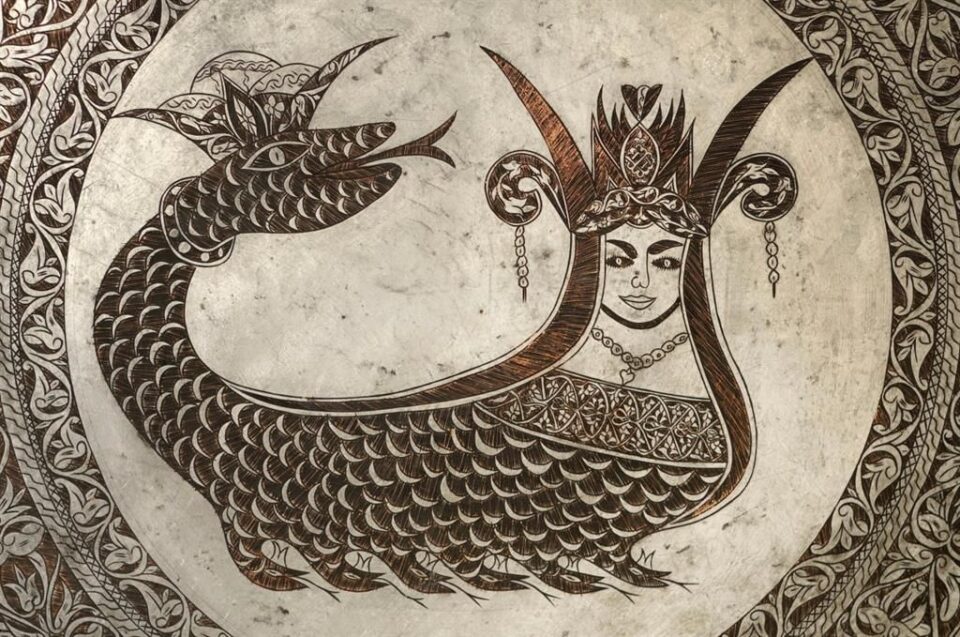
Sign: Cancer | Sign Ruler: Moon | Decan Ruler: Venus Element: Water | Mode: Cardinal
The Moon rules Cancer by domicile, governing growth, nourishment, fertility, and change. Venus rules this decan by face and finds herself in a sign naturally sympathetic to her moist and fertile nature. Together, the Moon and Venus create a face associated with affection, attraction, imagination, subtle arts, and the cultivation of harmony.
Core Principle: Attraction through subtlety.
Liber Hermetis
“The first decan of Cancer has the face of Venus. Its name is Seneptois. It has the form of a serpent joined with the face of a dog. In the tail, however, a heart like a pine [cone] [?]. It has half of its tail turned down and from either part of the side of the heart slender serpents rise above the dog’s head.”
Picatrix
“In the first face of Cancer ascends a man with crooked fingers and a bent-over head. His body is like a horse. He has white feet, and fig leaves cover his body. This is the face of instruction, knowledge, love, subtlety, and craft. This is its form.”
There is a place, in the unmapped country of grief, where the heart is still wholly faithful to what it loved, still organised around an attachment that in the visible world, has ceased to be reciprocal. This grieving heart does not know what to do with itself, and what remains, is a current of feeling seeking to attach, but which finds only the cool empty air.
The figure who guards this threshold is a strange composite being. Grief is itself a hybrid state, we are like some half-formed creature caught between worlds, instinctive and unintegrated. The dog-like face suggests fidelity, it still listens for a familiar step, the serpent’s body, a coiled, recursive nature of feeling with nowhere to go, turning back upon itself, again and again, in the dark.
This is the territory of Cancer I, where Venus enters the ancient and watery house of the Moon, to discover there a love still fully alive but now without its accustomed channel. The Golden Dawn gave this decan to The Two of Cups and named it Love, and it is here, in the Moon’s nurturing domain, that we slowly and gently, with the patience proper to water seeking its level, to learn the craft of loving what cannot be held.
This is the decan of love’s re-education; subtle and unhurried, it asks nothing dramatic, only the quiet, persistent willingness to let affection find new and stranger shapes as we learn to trust the slender serpents rising from either side of the heart as a sign of love’s own ingenuity, reaching out along whatever pathways remain available to it. If the form this takes is at first only half-recognisable, not yet beautiful in any way, this too is part of the craft Venus. Love, deprived of its accustomed object, does not die, but goes underground, becomes strange, and waits there, patient as water, for the slow unfolding of whatever new vessel will eventually be able to hold it.
The energy of attachment is still fully active; it has simply lost its destination. That’s a very particular feature of early grief, not sadness exactly, but a kind of directionless yearning, the heart still reaching by reflex toward where the loved thing used to be.
This is why the piece doesn’t yet talk about resolution or instruction in any developed sense, only the seed of it, present in the fig leaves but not yet enacted.
Matters are unresolved, slightly unreal, like the rather grotesque images associated with it. The hybridity itself seems to be an important interpretive key. A creature that is animal, serpent and human all at once, not yet settled into one form, describes quite clearly the experiences of someone in early grief who is not yet one coherent self, who is operating on old instinct, still seeking the absent person (the loyal animal), partly on something more primitive (the serpent, coiling back on itself), and not yet capable of upright, integrated selfhood (the not yet fully human form).
This strange figure seems to serve as a Threshold Guardian, testing whether our hero is ready to cross; guardians are often strange, hybrid creatures that represent the unfamiliar logic of the world we are about to enter. The fig leaves, sacred to Venus, seem to be the clearest classical symbol here, unmistakably linked to the Eden narrative and knowledge gained through loss of innocence, implying the idea of future instruction within an otherwise instinctual, unintegrated image.
The Tarot of Grief
What the soul refuses to hold becomes the door you must walk through. What is buried, buries you, until you carry it home as light…..

Another brilliant concept from the Leu-Grant partnership

Hymns from the Labyrinth of Loss
The Thoth Journey Tarot
an oracle for change
Our choices reveal paths to the extraordinary, for out of curiosity comes creativity and from courage is born change……..follow the journey.


Leave a Reply