The Full Moon in Aquarius July 29th
It is not yet August, and already the garden has the look of something spent. I am all tanned legs and a bit sleepy from too much sun, sitting rather smugly among jars of blackcurrant jam and wondering how many more courgettes one woman can reasonably be expected to eat; the Sun has left the watery realm of Cancer behind and Ireland, of all places, a country that seems permanently on the verge of drowning, has just announced a countrywide hosepipe ban. This act of bureaucratic theatre is so absurd it could only happen under one sign! We have entered the Lion’s Den.

The coming Full Moon finds Lady Lunar at seven degrees Aquarius, pressed close to Pluto, staring down the Sun across the sky from Leo. Jupiter, meanwhile, sits cazimi, in the heart of the Sun. This is the great planetary burning, the fate that visits every planet as it crosses the Sun’s threshold, and tradition has always read it two ways at once. It is a death and a rebirth and also a vanishing. A planet too close to the Sun cannot be seen; the ancients believed its powers went into hiding along with its light, and so Jupiter, the great benefactor, bringer of justice, generosity and expansive good fortune, finds his qualities muted just now, tucked out of sight. While the teacher’s back is turned, who can say what mischief gets worked at the back of the classroom, on the stage where nations play.
I find this particularly interesting because the American Sibly chart takes its own Mars return only hours before this Full Moon perfects. Both charts, the Full Moon set for Washington and the Mars return itself, rise at very late degrees, and late-rising degrees have always spoken to me of last chances, of doors closing, of the point past which there is no doubling back. Layer onto this the South Node’s recent slide into Leo, where it will remain until March 2028, and the omens sharpen. We should perhaps brace ourselves to see the sign of Leo at its very worst, its shadow dragged into daylight for the whole world to watch; how much dirty washing are we prepared to tolerate, I wonder?
Several charts I’ve been sitting with lately have been highlighting the last ten degrees of Leo, and the repetition is becoming difficult to ignore, so I think I need to start talking about it, to follow that thread a little further.
Two Lions, Not One

The old astrological traditions generally offer us not one lion but two, and I think we are watching the tension between them play out upon the world stage today.
Marcus Manilius writes in the Astronomica that “the Lion gives courage for noble deeds and makes men eager for glory,” while elsewhere observing that those born beneath the sign seek honours, kingdoms and triumphs. Ptolemy is characteristically concise, describing Leo as masculine, fiery, commanding and royal. Across the classical astrological tradition, the lion belongs naturally to rulers, judges and those entrusted with authority; the lion representing legitimate authority, inherited kingship and sovereignty sanctioned by something greater than any individual ruler.
However, another version paces in the shadows, lurking behind that flashy front, and from the ancient Greek tradition, we receive the story of the Nemean Lion, born of Typhon and Echidna, and belonging to the monstrous lineage that also produced the Hydra and the Chimaera. His hide turns aside every ordinary weapon and he cannot be defeated by conventional means because he himself stands outside the ordinary laws that govern other creatures.
Here lies the oldest deception of power. The false lion clothes himself in the symbols of the true one, speaking the language of legitimacy, justice and noble purpose while serving only his own appetite. He borrows the appearance of rightful kingship even as he rejects every restraint that gives kingship its legitimacy. Every age, perhaps, must decide which lion has taken the throne.

The King’s Own Hunger
Long before the lion became the polished emblem of monarchy, he represented something far older and far more dangerous. The oldest surviving literature presents the lion not as a symbol of noble kingship but as the embodiment of raw power itself.
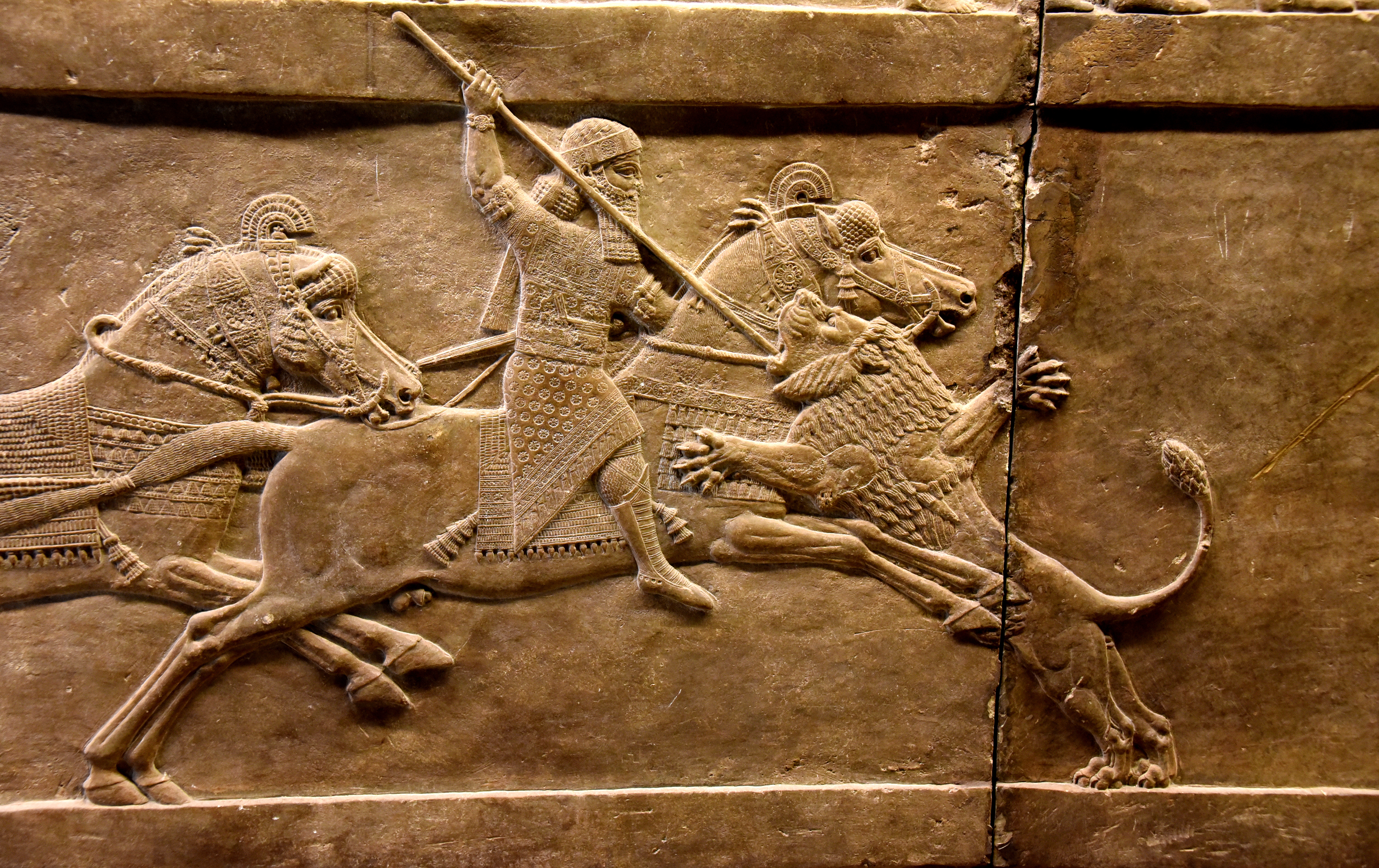
In the Epic of Gilgamesh, drawn from Mesopotamian literature, the lion isn’t simply a dangerous beast. He is the king’s own nature made visible. Gilgamesh hunts lions, seizes them bare-handed and wears their skins across his shoulders, proving that no man deserves to rule until he has mastered the fiercest force in creation.
Yet the epic begins with Gilgamesh himself as a tyrant. His immense strength answers to nothing, not compassion, not restraint, not any law but his own appetite. He rules by domination rather than justice. The lion therefore becomes less a trophy than a mirror, reflecting the king’s hunger for power, his thirst for glory and his willingness to bend both enemies and subjects alike to his will. Only through suffering, friendship and finally grief does Gilgamesh discover that the greatest conquest is not over the beast outside him but over the beast within.
It is, in other words, Judah’s lion and the Nemean lion wearing the same crown, in the same man, at different points in a single life, and the epic’s real subject is which one gets to keep it.
The Land Beneath the Lion

For thousands of years, traditional astrologers have laid the mantle of Aries and its ruler Mars across the lands of the Levant: the territory we now call Israel, Palestine, Lebanon, and the western reaches of Jordan and Syria. It is an old correspondence, and an apt one. This is ground that has been fought over, conquered and reconquered since memory began, where questions of kingship, identity and survival have never really fallen silent.
The closing degrees of Leo add another layer to that symbolism. Mars rules the final decan of the sign by face and extends his influence into its closing degrees through the Ptolemaic terms, fusing the Sun’s royal authority with Mars’s appetite for action, confrontation and conquest. It is a remarkably martial corner of the zodiac, and one whose symbolism seems strangely at home in a land whose history has been written repeatedly through the language of kingship and war.
Here, too, the lion reveals both his highest and his lowest expressions: at his noblest, courage and steadfast leadership, the willingness to stand between danger and those under his protection; left to his shadow, conquest, pride, vengeance, and an appetite for blood and recognition that no amount of victory ever manages to satisfy, the king ceases to guard the kingdom and instead begins to feed upon it.
At the heart of that landscape stands Jerusalem, whose very name may preserve a memory older than the conflicts for which it is now known. Long before the rise of ancient Israel, the city appears in Late Bronze Age records as Urusalim, usually translated as “Foundation of Shalem” or “City of Shalem.” Shalem was an ancient Canaanite deity whose name derives from the Semitic root meaning completeness, fulfilment and wholeness, the same root that would later give rise to the Hebrew shalom, peace.
There is a quiet irony here. The city that has become one of history’s greatest symbols of conflict may originally have carried the name of a deity whose sphere was not war at all, but completion. Shalem governed the day’s peaceful ending, the settling of creation back into its proper order. Little survives of his worship, yet the city’s ancient name seems to preserve an enduring memory of harmony beneath centuries of struggle, as though the deepest longing of the land has always been restoration rather than conquest.
What the Nations Carry

If the lion has both a noble face and a devouring one, then astrology invites us to ask where those archetypes are finding expression today. The present moment offers no shortage of examples.
Donald Trump belongs to the Pluto-in-Leo generation, those born between 1937 and 1956. His Ascendant falls in late Leo, while his Mars rises in the sign’s twenty-seventh degree. He is, in every sense the tradition would recognise, a figure carrying the symbolism of the lion close to the surface. His natal chart interlocks tightly with the American Sibly chart itself, and he carries the collective’s projections in the way certain individuals seem destined to do. To many, it can appear as though every ill in the modern world traces back to one man or one leader, depending upon which side of the political divide one occupies. Yet history is never born from a single individual. What we are witnessing is more likely the accumulated momentum of decades, perhaps centuries, of choices made by men driven by the ancient appetites symbolised by the lion itself.
The Pluto-in-Leo generation is now coming towards the end of their years, although two, noticeably, remain. Both Donald Trump and Benjamin Netanyahu stand out in this respect, not only because both belong to that generation but because both carry Mars in the twenty-seventh degree of Leo; they are literally “Brothers in Arms”. Around them stands a younger generation, and although not from the Pluto in Leo cohort, they have similarly prominent Leo placements: Nicolás Maduro with Mars in Leo; Javier Milei with his Moon there; Anthony Albanese, Emmanuel Macron and Mette Frederiksen all carrying Mars in the sign; Mojtaba Khamenei with Moon and Venus in Leo; Mohammed bin Salman with Mercury, Venus and Mars gathered there; Volodymyr Zelensky likewise carrying Mars in Leo. Whether coincidence or meaningful pattern, Mars in Leo appears with remarkable frequency among those who rise to positions of national leadership.
The nations themselves tell a similar story. Israel’s founding chart of 14 May 1948 reads as a parliament of Leo placements, with Moon, Pluto, Saturn and Mars gathered there in the tenth house. Mars occupies the twenty-ninth degree of Leo itself, ruling Aries from the cusp of the seventh house, a striking signature for a nation whose history has unfolded through continual questions of conflict and survival. Pakistan, which has more recently presented itself as a diplomatic intermediary, also possesses a heavily populated Leo, while Qatar, whose role in negotiations has become increasingly significant, carries Mercury, ruler of its Ascendant, at that same fateful twenty-ninth degree. Whatever one concludes from these charts, the repetition of these late Leonine degrees is difficult to overlook.
Deeper Echoes
Following this thread backwards through history, the pattern does not disappear. Instead, it could be gathering depth.
The Balfour Declaration of 1917, which opened the political road toward the modern State of Israel, was preceded by a Full Moon whose chart shares the same twenty-ninth degree of Libra rising as does Israel’s founding horoscope itself. More remarkable still, Mars in that Balfour lunation stands at twenty-nine degrees of Leo, separated by only four minutes of arc from its position in the 1948 Israeli national chart.
Travel back almost a thousand years to the official beginning of the First Crusade on 15 August 1096, as Europe pledged to deliver the holy lands from the hands of the so-called “infidel”, and once again the closing degrees of Leo command attention. This time it is the Sun itself that occupies the twenty-ninth degree, illuminating a campaign whose consequences continue to reverberate through relations between East and West.
Further back still, to the New Moon preceding the destruction of the Second Temple in Jerusalem, the same region of the zodiac once again becomes crowded; a New Moon in the 29th degree of Leo, preceded by Mercury, Venus and Jupiter all gathering in the sign of the lion. In some manner, the twenty-ninth degree of Leo echoes, as though history repeatedly returns to this narrow celestial threshold whenever profound transformations unfold in the same small corner of the world.
One chart might easily be dismissed, two might be coincidence, yet as the centuries accumulate, these repeated appearances begin to resemble ripples sounding the same ancient note across vastly different historical landscapes.

The Lion’s Last Test
It is, of course, entirely possible that these recurring degrees signify nothing more than an intriguing pattern. Astrology offers correspondences rather than proofs, and history has never been so obliging as to arrange itself into tidy demonstrations. Yet when the same narrow band of Leo continues to appear across two thousand years of upheaval centred upon the same region of the world, it becomes increasingly difficult not to pause and ask why. Perhaps the answer lies in the lion himself.
Modern astrology has tended to soften Leo into a symbol of confidence, creativity and personal expression. The older traditions paint a more demanding picture. They remind us that the lion is first and foremost a creature of appetite. He seeks dominion, territory and recognition. At his highest he becomes the courageous guardian, the ruler who willingly places himself between danger and those under his protection. At his lowest he becomes the tyrant, convinced that power alone grants legitimacy and that victory itself is its own justification.
This, perhaps, is why the ancient astrologers entrusted the closing degrees of Leo to Mars. Here the royal authority of the Sun reaches its greatest test. Kingship is measured not by splendour but by restraint; not by the ability to conquer, but by the wisdom to know when conquest must end. Every kingdom eventually reaches the moment when its greatest danger no longer comes from beyond its borders but from the hunger growing within its own walls.
As this Full Moon shines across the Leo–Aquarius axis, illuminating the tension between personal power and the collective good, perhaps it is not merely exposing the fortunes of nations. Perhaps it is holding up the oldest mirror of all. The lion has never simply represented the ruler. He has represented the ruler’s greatest temptation. The final question, now as then, is not who wears the crown, but whether the one who wears it has mastered the lion within, or has he instead become the Nemean beast, with bloodlust dripping from his jaws?

The Thoth Journey Tarot
an oracle for change
Our choices reveal paths to the extraordinary, for out of curiosity comes creativity and from courage is born change……..follow the journey.

The Tarot of Grief
What the soul refuses to hold becomes the door you must walk through. What is buried, buries you, until you carry it home as light…..

Another brilliant concept from the Leu-Grant partnership

Hymns from the Labyrinth of Loss


Leave a Reply