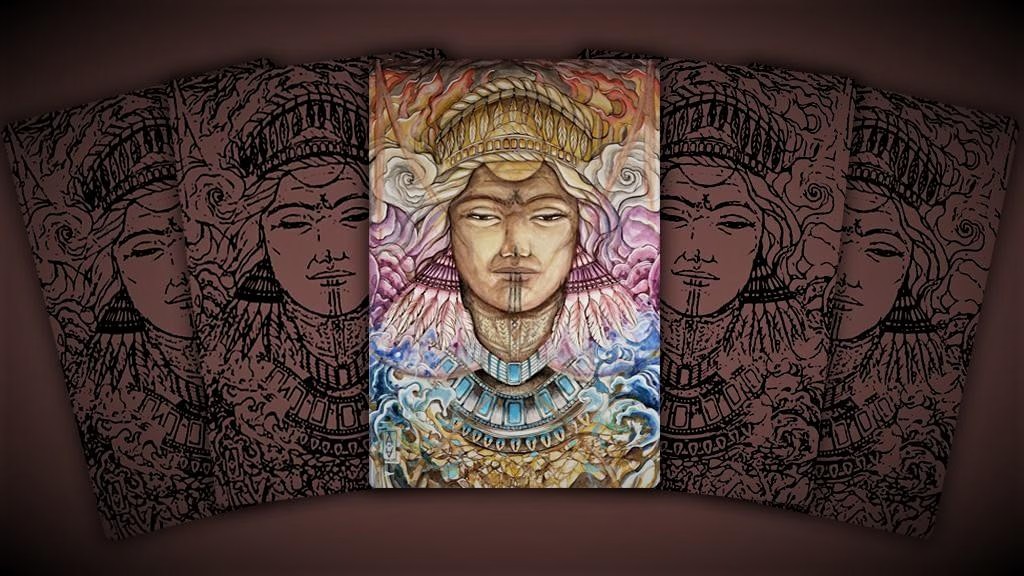
Grief is not an event. It is a journey, and like every journey worth taking, it has a shape. Long before psychology gave that shape a name, long before writing had recorded it on tablets or paper, myth had already given it form, mapping it out in our human story. Whether it was couched in terms such as the call, the threshold, the descent, the ordeal or the return, the story of grief is as old as existence itself.
The narrative of what it means to be human has been told through traditions so ancient that we still cannot chart their true origins, whilst more recently, psychology has charted the same terrain in clinical language: denial, anger, bargaining, depression, and acceptance, without ever using the word myth. We might these two maps of different countries, written in different languages, but perhaps they are one map drawn twice, in different inks.
Grief is universal in structure but never uniform in expression, and through the lens of astrology & tarot, I am seeking to develop a new framework in which the two might combine to help us explore grief, something we all encounter in so many different ways, every day of our lives.
This is the hinge on which The Tarot of Grief turns. Each court card supplies the structure of the descent, while its emotional register, stage by stage, discovers the buried inferior function that supplies the wound. The ordeal is not generic suffering but the precise place where this particular archetype’s denial, anger, and bargaining will cluster, because it is the place where this archetype is least equipped to look. The Princess of Wands does not grieve like the Queen of Cups; the Princess’s restless avoidance of stillness is not the Queen’s overprotection of memory. Each figure must eventually pass through the one door it has spent its whole life walking past, and what it carries back through that door, the elixir, is always some portion of the very function it once exiled.
The Importance of the 36 Decans: the 36@10 degree divisions of the zodiac.
If we adopt the understanding of the decans (and hence the 36 pip cards of the tarot) as living thresholds or gateways of experience, grief can be understood not as a single emotional state but as a journey through a series of distinct portals. Each portal opens onto a different landscape of loss, memory, longing, transformation, and eventual renewal. This is not a fixed sequence of stages, but each one is a symbolic chamber, governed by its own images, challenges, and wisdom. The experience of grief is initiatory, requiring repeated crossings into the unfamiliar territories of the soul.
In this model, each decan becomes a particular face of bereavement. One portal may confront us with shock and rupture, another with memory and yearning, another with anger, regret, or loneliness. Still others reveal acceptance, devotion, gratitude, or the rediscovery of meaning. The strange figures preserved in the ancient decan images may be understood as guardians of these thresholds, representing the psychological and spiritual realities encountered within each chamber. To enter a decan is to enter a specific mode of grieving, a particular relationship to absence and remembrance.
The decans are therefore seen here as maps of human transformation. Grief itself becomes a pilgrimage through the thirty-six faces, each offering a different experienc of attachment, separation, mortality, and continuity. Some faces speak of endurance, others surrender; some require confrontation, others contemplation. Together they describe the many forms through which loss reshapes the human heart.
At its heart, The Tarot of Grief proposes a simple but enduring truth: grief is not a path we walk to forget those we have loved. It is the path by which love itself is transformed. The ancient symbols preserved across centuries remind us that every ending contains the possibility of renewal, every trial carries the seed of wisdom, and every stage of sorrow invites the soul into a deeper understanding of what it truly means to live, to remember, and ultimately, to love.
:::

Libra II: The Benefactor
The Benefactor reveals one of grief’s more difficult paradoxes: sorrow and peace can coexist. Healing asks that sorrow be given a durable place within a life large enough to contain it. Here Saturn’s restriction becomes a blessing, for what cannot be changed is accepted, what remains valuable is protected, and what is sufficient is recognised…

Libra I: The Mediator
The ancient images present twin, upright figures, standing on scorpions, holding water jugs from which fine pipes release their contents in a continous, regulated flow. The justice portrayed here, is an ongoing practice, a steady, measured distribution, maintained against disruptive forces. The scorpions beneath the feet are symbolic of the venomous reactive impulse standing beneath…

Virgo III: The Examiner
We praise this knowledge like a final benediction, the insight grief most needs and most resists, that what was essential in the one who is gone has already been released into the world. The Mercurial sorting of the permanent from the perishable reveals an indestructible residue that no gate of any underworld can finally confiscate.…

Virgo II: The Petitioner
Venus in fall in Virgo has lost access to her most reliable gift, the quality of being simply received, of attracting without having to argue, of moving toward what she loves with the confidence of one who has rarely been refused. What she finds in Mercury’s exacting realm, in the mutable atmosphere of Virgo’s middle…

Virgo I: The Harvester
The First Decan of Virgo marks a profound transition in the zodiacal journey. Having passed through the fullness and generosity of Leo, consciousness now turns from an outward demonstration of vigour, towards stewardship. The question is no longer how life may be enjoyed, but how it may be tended so that its blessings endure.

Leo III: The Feast Lord
In the Epic of Gilgamesh, the king who went out into the wilderness in lion skins, who crossed the waters of death and asked the oldest question a grieving creature can ask- What survives? What endures? Where does the beloved go? Can the loss be undone?- returned to his city with that question unanswered in…

Leo II: The Noble Archer
The unknown land this decan governs is not simply a geographical unknown but an existential one, beyond the boundary of what the traveller has previously understood about loss, about love, about the self that continues when what it most loved has gone. Jupiter’s enlarging influence within the Sun’s own kingdom does not promise that this…

Leo I: The Victorious Beast
The traveller who arrives in this decan is in the dull heat of the trial, a territory where the question is no longer whether the worst can be endured but whether endurance itself can be sustained toward a destination with no visible end. What is being tested here is not courage in any dramatic sense…

Cancer III- The Protector
This is the territory of Cancer III, where the Moon inhabits her own sign, in her own face and finds no moderating influence, no planetary guest to introduce a foreign quality, only herself, distilled into the purest expression of what she has always been, the guardian of life at its most vulnerable, the force that…

Cancer II-The Remembrancer
Sign: Cancer | Sign Ruler: Moon | Decan Ruler: Mercury Element: Water | Mode: Cardinal The Moon rules Cancer by domicile, while Mercury rules this decan by face. Mercury has no major essential dignity in Cancer and must operate through the sign’s emotional and receptive nature. Thought and communication become closely linked with memory, feeling,…

Cancer I-The Enchanter
The energy of attachment is still fully active; it has simply lost its destination. That’s a very particular feature of early grief, not sadness exactly, but a kind of directionless yearning, the heart still reaching by reflex toward where the loved thing used to be.

Days Above The Year: The Heriu Renpet
What the structure offers is a guarantee of texture, the assurance that every quality encountered in grief has been named, presided over and honoured. At the heart of the structure sit the five days above the year, which are not a stage that comes at the end of the process but a vertical dimension that…

The Herald
There comes a moment in the long interior passage of sorrow when something stirs that has not stirred in what feels like an age of the world; when the voice, so long folded inward upon itself, so long turned away from the open air and the company of others and the bright demanding surface of…
